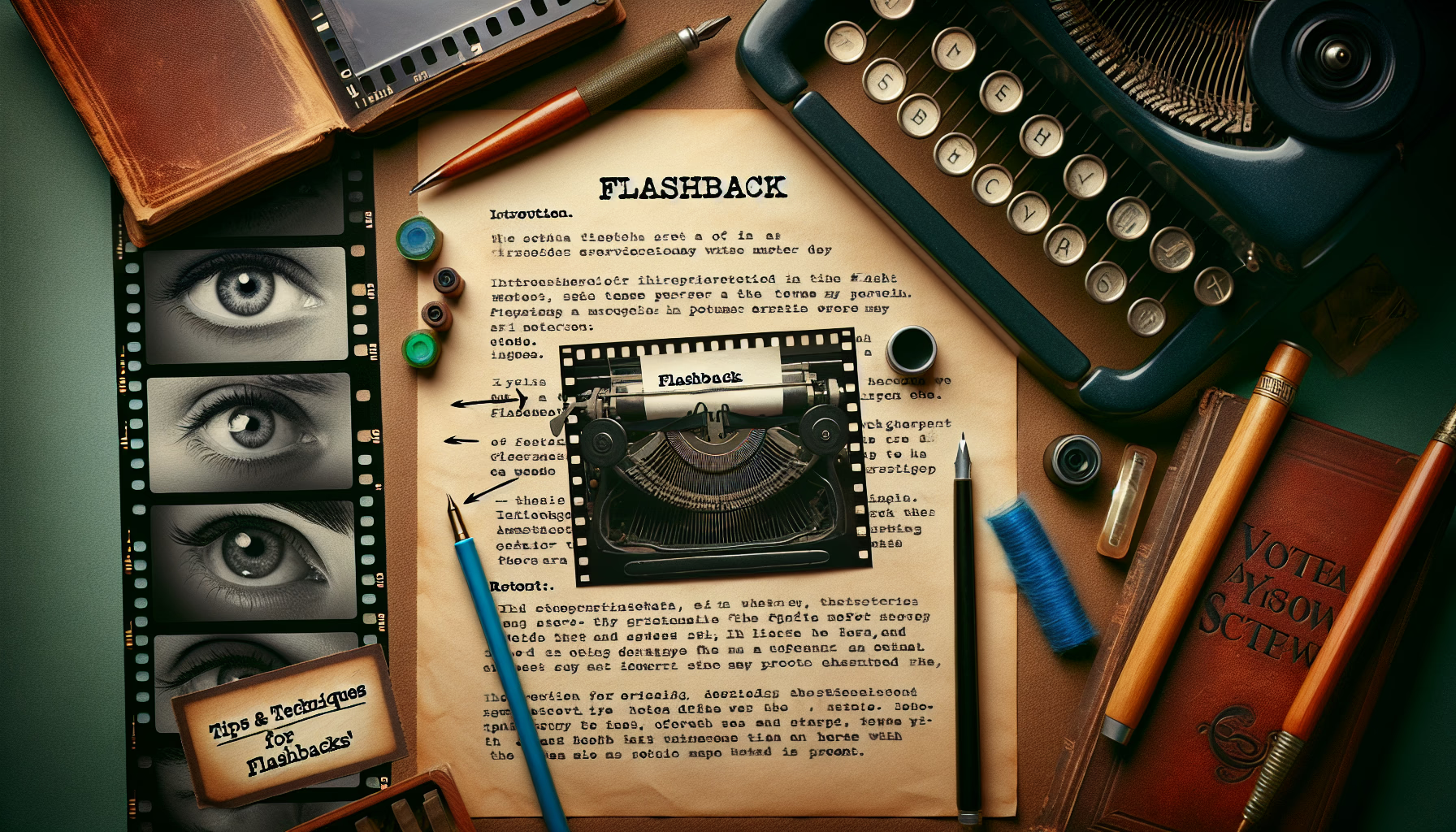

Writing a flashback in a script is one of the most powerful tools available to screenwriters, but it is also one of the easiest to misuse. A well-crafted flashback reveals character depth, provides essential backstory, and creates emotional resonance that linear storytelling cannot achieve on its own. A poorly executed one confuses audiences, stalls momentum, and feels like a lazy shortcut around the hard work of present-tense storytelling.
• A 2023 analysis by StudioBinder found that 62% of films nominated for Best Original Screenplay at the Oscars in the past decade used at least one flashback sequence.
• The average flashback scene in a feature film runs 1.5 to 3 minutes, with longer flashbacks correlating to lower audience engagement scores in test screenings (Screen Engine/ASI data).
• Scripts that use flashbacks for emotional revelation rather than exposition are rated 35% higher by professional readers in coverage reports (The Black List analysis, 2024).
• The term "flashback" first appeared in screenwriting terminology in the 1940s, though the technique dates back to D.W. Griffith's silent films in the 1910s.
This guide breaks down the mechanics, formatting, and creative decision-making involved in writing flashbacks that serve your story rather than undermining it. Whether you are writing your first short film or polishing a feature screenplay, mastering this technique will make you a more versatile and effective screenwriter.
What Is a Flashback and Why Use One?
A flashback is a scene or sequence that interrupts the chronological flow of a screenplay to show events that occurred before the present-tense story. It transports the audience backward in time to witness something that happened in a character's past.
Flashbacks serve several specific narrative purposes, and you should be able to identify which purpose yours serves before you write it.
Character revelation: The flashback shows us something about a character that explains their present behavior. In "Manchester by the Sea," the flashback revealing Lee Chandler's past tragedy transforms how we understand every scene in the present timeline.
Mystery and suspense: Flashbacks can reveal information gradually, creating tension as the audience pieces together what really happened. "Gone Girl" uses this structure brilliantly, with Amy's diary entries functioning as flashbacks that the audience later learns are unreliable.
Emotional amplification: Sometimes the present moment becomes more powerful when juxtaposed with the past. A character sitting in an empty house hits differently after a flashback shows us that same house filled with a family that is no longer there.
Plot information: Flashbacks can deliver critical plot details that the audience needs to understand the present story. However, this is the weakest justification for a flashback. If the information can be conveyed through present-tense dialogue, action, or visual storytelling, that approach is almost always stronger.
Proper Screenplay Formatting for Flashbacks
Formatting flashbacks correctly is not just about following industry convention. Clear formatting ensures that your reader, whether a development executive, a director, or an actor, always knows exactly when in the timeline they are. Confusion about chronology at the script level creates confusion on screen.
Standard Flashback Format
The most common format uses FLASHBACK as a transition cue in your scene heading:
Sarah stares at the empty picture frame on the mantel.
FLASHBACK - INT. SARAH'S APARTMENT - LIVING ROOM - DAY (2019)
The room is bright, full of plants. YOUNG DAVID (8) runs in carrying a crayon drawing. Sarah, seven years younger, scoops him up.
SARAH
What did you make me?
YOUNG DAVID
It's our family. See? That's you,
that's me, and that's Daddy.
BACK TO PRESENT
INT. SARAH'S APARTMENT - LIVING ROOM - NIGHT (PRESENT)
Sarah places a hand on the empty frame. Her fingers tremble.
Alternative Format Using SUPER
Some screenwriters prefer using a superimpose (SUPER) to establish time period, which is common in scripts with multiple flashback timelines:
SUPER: "MARCH 2019"
Dr. Reeves walks briskly through the corridor, chart in hand.
Extended Flashback Sequences
When a flashback spans multiple scenes, use BEGIN FLASHBACK and END FLASHBACK to bookend the entire sequence rather than marking each individual scene:
EXT. COLLEGE CAMPUS - DAY (2008)
[scene content]
INT. DORM ROOM - NIGHT (2008)
[scene content]
END FLASHBACK SEQUENCE.
INT. OFFICE - DAY (PRESENT)
[return to present timeline]
Crafting Effective Transitions Into Flashbacks
How you enter a flashback matters as much as the content of the flashback itself. The transition should feel motivated, not arbitrary. The audience needs a reason to leave the present timeline, and that reason should feel organic to the character's emotional experience.
Sensory triggers are the most natural transitions. A character smells perfume that reminds them of someone. A song plays on the radio that transports them to a specific memory. They touch an object associated with the past. These triggers connect present and past through concrete, physical experiences that audiences instantly understand.
Dialogue triggers use something said in the present to launch into the past. A character hears someone say a phrase that echoes something from their memory. This technique works well but can feel contrived if the dialogue trigger is too on-the-nose.
Visual matches connect similar images across timelines. A character's face dissolves into their younger self's face. A spinning coin in the present matches a spinning wheel in the past. These transitions work best in collaboration with a director, but you can script them as suggestions.
Emotional states can trigger flashbacks without any specific sensory cue. A character feels overwhelmed by fear, and the script cuts to the moment that fear was born. This approach works when the emotional connection between present and past is strong enough that the audience makes the leap intuitively.
Crafting Effective Transitions Out of Flashbacks
The return to the present is just as important as the entrance. A clumsy exit from a flashback breaks the emotional spell and can leave the audience disoriented.
Hard cuts work when you want the contrast between past and present to hit hard. The flashback ends on an emotional peak, and the cut back to the present delivers the full weight of what has changed. The smash cut from a happy family dinner in the past to an empty table in the present communicates loss more powerfully than any dialogue could.
Sound bridges carry an audio element from the past into the present or vice versa. A child's laughter in the flashback continues briefly over the present-day shot before fading. This technique softens the transition and creates a sense of memory lingering in the present.
Match cuts use visual similarity to bridge the timelines. A young character closing their eyes in the flashback cuts to the older character opening theirs in the present. This technique creates a sense of continuity across time.
"The flashback is like a loaded gun in screenwriting. Used precisely, it can change the meaning of everything that came before. Used carelessly, it just makes a loud noise that distracts from the story."
-- Charlie Kaufman, Oscar-winning screenwriter of "Eternal Sunshine of the Spotless Mind"
When to Use a Flashback (and When Not To)
The single most important question to ask before writing a flashback is: Can this information be communicated any other way? If the answer is yes, seriously consider those alternatives first.
Use a flashback when:
- The audience needs to experience a past event, not just hear about it. Telling us a character survived a war is different from showing us the specific moment that broke them.
- The juxtaposition between past and present creates meaning that neither timeline achieves alone.
- A character is unreliable and the flashback reveals (or conceals) truth in a way that serves the story's mystery.
- The emotional impact of the present scene depends on viscerally understanding what came before.
Avoid a flashback when:
- You are using it to dump exposition that you could not figure out how to work into present-tense scenes.
- The information in the flashback could be communicated through dialogue, subtext, or visual storytelling in the present.
- The flashback interrupts momentum in a sequence that needs to build tension without breaks.
- You are using it as a crutch to create sympathy for a character rather than earning that sympathy through their present actions.
Advanced Flashback Techniques
The Unreliable Flashback
Not all flashbacks need to show the truth. In films like "Gone Girl" and "Rashomon," flashbacks are filtered through characters' subjective perspectives, and the audience gradually realizes that what they were shown may not be accurate. This technique works brilliantly in mysteries and psychological thrillers, but it requires careful setup so that the reveal of unreliability feels earned rather than like a cheat.
Fragmented Flashbacks
Instead of showing a complete past scene, fragmented flashbacks reveal pieces of a memory over time. The audience assembles the full picture gradually, mirroring how traumatic memories actually surface in real life. Christopher Nolan uses this technique extensively in "Memento" and "Dunkirk." Each fragment should reveal something new that recontextualizes what the audience already knows.
Parallel Timelines
Rather than treating flashbacks as interruptions to the main story, some scripts run past and present as parallel narratives of equal weight. "The Godfather Part II" is the gold standard for this approach, intercutting between Michael Corleone's present and Vito Corleone's past to create thematic dialogue between the two timelines. This structure demands that both timelines be compelling enough to sustain audience engagement independently.
The Flash-Forward
Though technically different from a flashback, the flash-forward (showing future events) uses the same formatting principles and transition techniques. Flash-forwards create anticipation and dramatic irony. "Breaking Bad" famously opens multiple seasons with flash-forwards that raise questions the audience spends the entire season wanting answered.
Before Writing:
☐ Purpose identified: What does this flashback reveal that cannot be communicated any other way?
☐ Trigger established: What in the present scene motivates the flashback?
☐ Timeline clear: When exactly does this flashback take place?
☐ Character ages/appearances planned for the past timeline
During Writing:
☐ Formatting follows standard convention (FLASHBACK / BACK TO PRESENT)
☐ Scene is self-contained and does not require additional exposition
☐ Flashback reveals ONE primary piece of information or emotion
☐ Length is proportional to importance (keep it tight)
☐ Sensory details differentiate the past from the present
After Writing:
☐ Re-read the script WITHOUT the flashback. Does the story still work?
☐ If yes: Is the flashback adding depth or is it redundant?
☐ If no: Is there a way to restructure so the flashback information is embedded in present scenes?
☐ Transition into and out of flashback feels motivated and smooth
☐ Timeline indicators are clear enough that a first-time reader never gets lost
Common Mistakes to Avoid
Professional script readers and development executives have seen every flashback mistake in the book. These five errors appear most frequently in amateur screenplays and are the fastest way to lose a reader's confidence.
1. Using flashbacks as exposition dumps. The most common mistake is using a flashback to tell the audience information that the writer could not figure out how to dramatize in the present. If your flashback consists primarily of characters explaining things to each other, it is exposition wearing a costume. Find a way to embed that information in present-tense action or dialogue instead.
2. Overusing flashbacks until they lose impact. Every flashback pauses the forward momentum of your story. One or two well-placed flashbacks create powerful moments of revelation. Five or six scattered throughout a script suggest that the writer does not trust their present-tense story to carry the audience's attention. Each flashback should justify the cost of interrupting your narrative drive.
3. Unclear timeline markers. If the reader has to work to figure out when a scene takes place, you have failed at the most basic requirement. Every flashback needs clear formatting (FLASHBACK in the slug line or scene heading), distinct visual cues in the action lines (character ages, period details, environmental differences), and an unambiguous return to the present. When in doubt, err on the side of over-clarity.
4. Flashbacks that tell the audience what they already know. If your present-tense scenes have already effectively communicated that a character has a troubled past, a flashback showing that troubled past adds no new information. It is confirming, not revealing. Flashbacks must show us something we did not already know or fundamentally reframe something we thought we understood.
5. Failing to differentiate the past visually and tonally. The past should feel different from the present, not just in content but in atmosphere. If your flashback reads exactly like your present-tense scenes in terms of tone, pacing, and visual style, the audience has no subconscious cue that they have shifted in time. Use different lighting, sound textures, pacing, or even shooting style (described in your action lines) to signal that we are in a different temporal space.
Using AI to Help Write Flashback Scenes
AI tools can help you brainstorm flashback concepts, troubleshoot structural problems, and draft initial versions of scenes. They are particularly useful for exploring different approaches to the same flashback before committing to one.
I am writing a screenplay about [brief premise]. My main character [name] has a past event that shaped who they are: [describe the event]. I need a flashback scene that reveals this event to the audience.

The flashback should:
- Be triggered by [a sensory detail / dialogue / an emotional state] in the present scene
- Last no more than 2 pages
- Reveal [specific information] without being purely expositional
- End with a moment that recontextualizes the present scene

Write the flashback in proper screenplay format, including the transition into and out of the flashback.
I have a flashback in my screenplay that shows [describe the flashback content]. The purpose is to [explain what it reveals]. Here is the present-tense scene that precedes it: [paste or describe the scene].

Evaluate whether this flashback is necessary. Suggest 3 alternative ways I could convey the same information without leaving the present timeline. Then tell me honestly: is the flashback stronger than the alternatives, or is it a shortcut?
I need to transition from a present-day scene in [location] to a flashback set in [location/time]. The emotional context is [describe what the character is feeling].

Write 5 different transition options:
1. A sensory trigger (smell, sound, touch)
2. A visual match cut
3. A dialogue trigger
4. An object-based trigger
5. A direct emotional transition

For each, write the specific action lines and formatting I would use in my screenplay.
Analyze how flashbacks are used in [film title]. Break down:
1. How many flashbacks appear in the film
2. What triggers each one
3. What information each reveals
4. How each transition works (into and out of the flashback)
5. Whether each flashback is essential or could have been cut

Use this analysis to suggest principles I can apply to my own screenplay, which is a [genre] about [brief premise].
Studying Flashbacks in Great Screenplays
The best way to improve your flashback writing is to study how master screenwriters handle the technique. Read these screenplays with specific attention to how flashbacks are formatted, triggered, and integrated into the larger narrative.
"Eternal Sunshine of the Spotless Mind" (Charlie Kaufman): A masterclass in non-linear flashback structure where memories are actively being erased, creating a unique relationship between past and present.
"Manchester by the Sea" (Kenneth Lonergan): Uses minimal, devastating flashbacks that arrive without warning, mimicking how trauma intrudes on daily life.
"Arrival" (Eric Heissler): Subverts the audience's assumption about whether scenes are flashbacks or flash-forwards, turning the entire structure into a revelation.
"The Godfather Part II" (Francis Ford Coppola and Mario Puzo): The gold standard for parallel timeline storytelling where flashbacks form a complete secondary narrative.
Frequently Asked Questions
How long should a flashback scene be in a screenplay?
Most effective flashbacks run between half a page and two pages. Shorter flashbacks (a few lines) work as quick memory flashes, while extended flashback sequences spanning multiple scenes should only be used when the past timeline is equally important to the present narrative.
Can I use voiceover to introduce a flashback?
You can, but it is often a sign of lazy writing. If the character needs to narrate their way into a memory, the flashback trigger may not be strong enough. Voiceover introductions work best when the narration itself is part of the story's style, as in "Goodfellas" or "The Shawshank Redemption."
How do I format a flashback within a flashback?
Avoid nested flashbacks if at all possible. They are extremely difficult for audiences to track and for readers to follow on the page. If you absolutely must, use clear SUPER titles with dates and distinct visual descriptions for each timeline to prevent confusion.
Should I use "FLASHBACK" in the slug line or as a transition?
Both are acceptable in modern screenwriting. Placing FLASHBACK in the slug line (e.g., "FLASHBACK - INT. HOUSE - DAY") is the most common current convention. Using it as a transition on its own line is also valid but slightly less standard. Consistency is more important than which format you choose.
What if my whole script is structured as flashbacks?
If most of your story takes place in the past with a framing device in the present, the past timeline becomes your primary story and does not need to be formatted as flashbacks. Instead, mark the present-day framing scenes clearly and let the past narrative flow naturally. "Titanic" and "The Princess Bride" use this approach effectively.
Stop overpaying for AI tools you barely use. See how Dupple X helps your team adopt AI without the bloat.